The 5 AI prompts that turn a rambled shift into clean, objective documentation — and a rushed handoff into a proper SBAR.
The 5 prompts that deliver the fastest wins from AI for Nurses — the Master Shift Note, the SBAR builder and more. In your inbox in about a minute, updated free whenever the tools change.
Runs on the free version of ChatGPT. No subscription, nothing to buy, nothing to install beyond what’s on your phone now. One-click unsubscribe, and I never share your email — see the privacy policy.
Talk the shift into your phone, get back an objective note ordered the way your unit charts it: assessment, interventions, response, communication, plan. Long-term care, home health, behavioral health and ED variants included.
The escalation you need to make right now, structured properly — situation, background, assessment, recommendation — from the mess in your head, before you pick up the phone.
The structurer that separates what you observed from what you concluded: times, sequence, actions taken, who was notified. Gaps stay gaps. Nothing padded, nothing softened.
The schedule request, declining the extra shift without the guilt essay, the pattern conversation with your charge nurse, and the written concern that can’t be brushed off because there’s nothing in it to argue with.
The application you keep putting off: resume rebuild in clean US format, a behavioral-interview story bank built from your own shifts, and prep that maps your examples to the questions they actually ask.
The CE log built from what you actually did, the portfolio gap-mapper, the quizmaster that tests you on your own notes, and the travel-nurse profile that gets you the contracts you want.
“Day two post right hip, vitals stable all shift, pain came down to three out of ten after the lunchtime pain med, ambulated to the chair twice with PT, wound dry and intact under the dressing, tolerated a full diet, family in this afternoon and updated by the resident. Bit of ooze at the drain site this morning I wasn’t thrilled about, flagged it. Plan overnight is routine vitals and the usual DVT prophylaxis, and heads up for nights she gets anxious about the drain.”
Assessment: Day 2 post right total hip arthroplasty. Vital signs within normal limits for the shift. Pain reported as 3/10 following midday analgesia (previously higher). Wound dry and intact beneath dressing. Small amount of ooze noted at drain site this morning.
| Interventions | Ambulated to chair x2 with physical therapy. Dressing observed and drain site monitored. Analgesia administered as ordered. |
| Response | Pain settling post-analgesia. Tolerating full diet. Ambulating with assistance as planned. |
| Communication | Family updated this afternoon by the resident. Drain site ooze escalated and flagged for review. |
| Plan / flags for oncoming shift | Routine vital signs overnight. DVT prophylaxis as ordered. Monitor drain site. Flag: patient reports anxiety regarding the drain. |
Objective, ordered, nothing invented — and the patient is never identifiable. No name, no MRN, no room number. You chart it properly in your own system.
Every detail in that note came out of the ramble. Nothing was invented — anything you don’t say comes back as a question instead of a guess. This is the worked example from Chapter 4, and the prompt behind it is the first of the free five.
I’m Dan Harrigan. I build automation tools for a living. Every working day I do the thing this book teaches — talk a mess of notes at a machine and get a finished document back — so I’ve found out the hard way where it works and exactly where it will drop you in it.
What started this was watching people come off a twelve and then sit down to an hour of charting. That problem has been solved for about two years. Nobody told the floors, because everyone writing about AI is writing for people who sit down at work.
Two rules ride on every prompt in this book, and they’re non-negotiable: no patient is ever identifiable, and nothing clinical is ever asked or trusted. The machine organizes your words. The nursing is yours, and so is your license.
The United States Edition
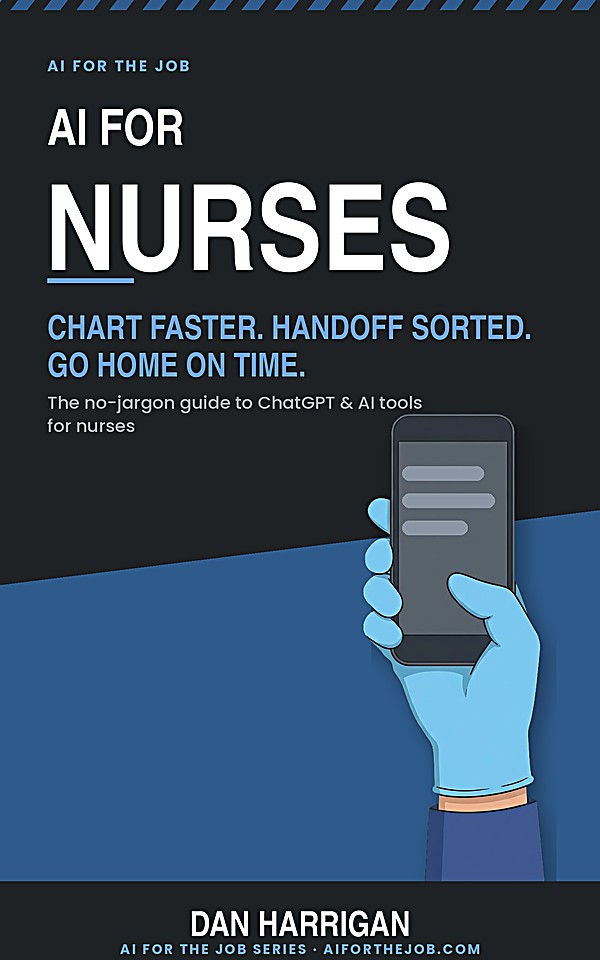
Book owners get the complete 36-prompt library as a free download — the Starter Five is just the warm-up. And the prompts are only the tools; the book is the system: the HIPAA-safe method that keeps patients de-identified without slowing you down, the 30-day plan that installs the whole thing ten minutes at a time, and the guardrails — what AI is genuinely good at in nursing, and exactly where it will burn you.
No hype, no jargon, nothing you need to be a tech person for. If you can give a verbal handoff, you can run every system in this book.
Kindle and paperback go up the same day. If you’re already on the list for the free prompts you’re covered — do nothing, the link comes to you.
Do I have to pay for anything to use this? No. Everything in the free pack and everything in the book runs on the free version of ChatGPT. If you already pay for one it’ll be a bit quicker, and that’s the whole difference.
Is this HIPAA-safe? The system is built so no patient is ever identifiable — none of the eighteen HIPAA identifiers go near a chat window. No name, no MRN, no date of birth, no room number. You write about “the patient” and chart it properly in your own system afterward. There’s a full chapter on this, and it’s the one that protects your license. Check your own facility’s policy too — some have specific rules about AI tools, and the book tells you what to ask.
Will it invent vitals or clinical detail? Every prompt is written to ask rather than guess. If you didn’t say it, it doesn’t go in. Fabricated documentation ends careers, so the fence is built into every prompt in the appendix — and there’s a whole chapter on where AI will burn you, because that’s the chapter that stops it happening.
Does it give clinical advice? No, and you shouldn’t let it. It never assesses, never diagnoses, never suggests an intervention. It takes what you said and structures it. Every clinical call in this book is yours, and the book says so on nearly every page.
Will it sound like a robot? Out of the box, yes — which is why most people try AI once and give up. The prompts are the fix: objective clinical language, no dramatizing, no opinions dressed as findings, no filler like “vitals stable, no concerns” unless you actually said what the vitals were.
Everyone’s selling AI right now. They are, and most of it is written for people who sit down at work. Take the free five, run them at the end of your next shift, and if they’re no good you unsubscribe in one click and you’re out an email address.
Five copy-and-paste prompts, one PDF, nothing to install. Run the first one at the end of your next shift.
Send Me the Five Prompts